
 MartinShields

To calculate the earthmoving capacity your next job needs, start with accurate cut-and-fill quantities, then account for soil type, moisture, haul distance, and site access. Estimate each machine’s output from its bucket or truck capacity and cycle time, and adjust for operating efficiency and downtime. A realistic schedule also needs room for delays and changing conditions. Miss one of these factors, and your equipment plan can fall short—here’s how to get the numbers right.
Key Takeaways
- Measure the site and calculate cut, fill, and stockpile volumes, keeping units consistent and recording whether quantities are in-place or excavated.
- Assess soil type, moisture, compaction, terrain, access, and haul routes; apply appropriate swell or compaction factors to estimate material movement.
- Determine each machine’s effective output using bucket capacity, material conditions, and average timed cycle—including loading, travel, dumping, and delays.
- Adjust rated production for operating efficiency, operator experience, weather, maintenance, inspections, shift changes, and likely breakdowns.
- Sum effective fleet output, multiply by available working hours, and compare it with remaining volume to confirm capacity and schedule.
Define the Work and Measure the Site
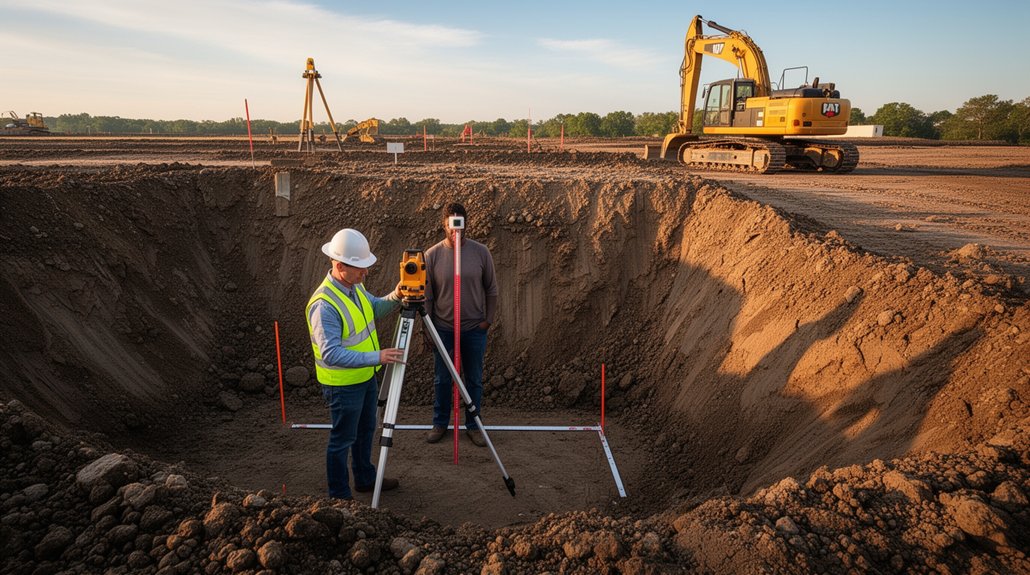
Before calculating earthmoving capacity, define exactly what the job requires. Specify whether you’ll excavate, grade, trench, or move stockpiled material, then estimate the total volume in cubic yards.
For irregular areas, divide the site into measurable sections and calculate each section separately. Record the required cut depth, fill depth, and finished elevations so your volume estimate reflects the actual scope.
Measure length and width with a tape, measuring wheel, or site plan; use a laser level or survey data to confirm elevations. Note whether your quantities represent material in place or after excavation, since volume can change when you loosen soil.
Document soil composition for estimating purposes, but reserve detailed site-condition analysis for the next planning step.
Finally, match your work schedule and production target to equipment maintenance needs, including inspection time, service intervals, and planned downtime.
Account for Soil, Terrain, and Site Access
Soil type, terrain, and access conditions affect how quickly equipment can move material. Identify whether you’ll work in clay, sand, gravel, or mixed ground; each material offers different traction and resistance. Check moisture and soil compaction, since wet or dense ground can slow travel, reduce bucket performance, and increase wear. Match machine size and tracks or tires to the surface, then allow for slower cycles on slopes, uneven ground, or soft areas.
Inspect entrances, turning space, overhead clearance, and haul routes before choosing equipment. Narrow gates or weak surfaces may limit machine size and require repositioning, while long routes reduce productive cycles. Plan around drainage, protected areas, and nearby structures to control environmental impact.
Record these constraints during your site review, and use them to adjust operating speed, equipment selection, and realistic daily production assumptions.
Calculate Cut, Fill, and Swell Volumes
Once you’ve accounted for site conditions, calculate how much material the job requires you to remove and place. Use survey elevations and design grades to divide the site into cut and fill areas. For each area, calculate volume from its length, width, and average depth, or use a grid or digital terrain model for irregular ground.
Add cut volumes and compare them with fill requirements to identify any surplus or shortfall.
Then adjust for swell: excavated soil usually expands, so its loose volume exceeds its in-place volume. Apply a swell factor suited to the material, and account for soil compaction when estimating how much loose fill will reach the required grade.
Keep units consistent and document assumptions. Accurate quantities support sound planning; equipment maintenance helps preserve reliable operation as work proceeds.
Estimate Earthmoving Capacity per Machine
To estimate a machine’s capacity, identify its bucket’s rated volume and adjust for typical fill.
Calculate cycle time by timing a full loading-and-dumping sequence under site conditions.
Then account for operator breaks, repositioning, and delays to estimate productive output per hour.
Determine Bucket Capacity
Before estimating how much earth a machine can move per hour, determine its bucket capacity—the volume it can carry in one load. Check the machine’s specifications for rated capacity, but don’t treat that number as the amount you’ll move every time.
Bucket sizing depends on the material’s density, moisture, and tendency to cling or spill. Match the bucket to your material handling needs and the machine’s operating limits.
Use the bucket’s struck capacity for a level load; use heaped capacity only when the material forms a stable mound above the bucket’s sides.
If you know the bucket volume in cubic yards, convert it to cubic feet by multiplying by 27. Then account for fill factor: multiply rated volume by the expected percentage filled. This gives you a realistic load volume for estimating production.
Calculate Cycle Time
After estimating the bucket’s usable load, measure how long the machine takes to complete a full cycle. Start timing when the bucket enters the material; stop when it returns to the same position, ready for the next pass. Include digging, loading, swinging, dumping, and returning.
Record several cycles under representative conditions, then calculate the average in seconds. Don’t rely on a single pass: changing haul distance, material type, operator technique, or soil compaction can alter cycle time. Keep the loading and dumping points consistent during your measurements so you can compare results reliably.
Check the manufacturer’s cycle-time guidance, but use field observations for your estimate. Confirm that equipment maintenance is current, since worn components or hydraulic issues can slow movement.
Divide 3,600 seconds by average cycle time to estimate cycles per hour.
Adjust for Efficiency
Once you know the theoretical cycles per hour, reduce that figure to account for delays and working conditions. Multiply theoretical output by an efficiency factor to estimate usable capacity.
For example, a 50-minute productive hour gives you an 83% factor; apply it to the machine’s theoretical hourly production.
Choose a factor that reflects your site, not a generic best case. Include time lost to repositioning, truck queues, material changes, fueling, and routine checks.
Mud, steep grades, tight access, and poor visibility can slow each cycle, so lower your estimate when these conditions persist.
Protect efficiency through planned machine maintenance and operator training. Keep cutting edges, tires, tracks, and hydraulics in working order, and train operators to load consistently, minimize unnecessary travel, and follow safe cycle patterns.
Track actual production by shift, then adjust your factor using recorded results.
Adjust for Haul Distance and Cycle Time
Measure the haul distance along the actual route, not the straight-line map distance.
Calculate cycle time by adding loading, travel, dumping, and return time.
Use that cycle time to adjust fleet capacity for the volume you can move per shift.
Measure Haul Distance
To adjust earthmoving capacity for haul distance, measure the loaded and return routes along the actual travel path, not as a straight line. Trace each route from the loading point to the dump area, accounting for turns, ramps, detours, and one-way traffic. Use a site plan, measuring wheel, or GPS to record distances, then verify them on the ground.
Measure loaded and empty legs separately when they follow different paths. Note changes in grade and surface condition because steep slopes, soft ground, or soil compaction can affect the usable route and equipment choice.
Identify narrow sections, crossings, and congestion points that may require alternate access. Record measurements consistently in feet or meters, and update them when the haul road changes.
Accurate distances support realistic planning and equipment maintenance decisions.
Calculate Cycle Time
Calculate cycle time by adding each machine’s loading, loaded travel, dumping, return travel, and delay times. Record each segment under typical site conditions, then total the minutes per trip.
Use the measured haul distance to estimate travel time, but account for grade, surface quality, turns, congestion, and speed limits. Loaded and empty trips may take different amounts of time, so calculate them separately.
Include delays for spotting, maneuvering, waiting, or repositioning; don’t treat them as constant if site conditions vary.
Check your estimate against timed production runs, then revise it as the haul route changes. Soil stabilization or material compaction work may alter access, rolling resistance, or travel speed.
Recalculate cycle time after those conditions change, using current distances and observed machine performance to keep your earthmoving capacity estimate grounded in actual jobsite conditions.
Adjust Fleet Capacity
Adjust fleet capacity to match the haul distance and the cycle time you observed, not the machine’s rated output alone. Longer hauls increase travel time and reduce loads per hour, so calculate each truck’s effective output using measured travel, loading, dumping, and return times.
Compare truck capacity with excavator production: too few trucks leave the excavator waiting, while too many create queues and raise costs.
Use your cycle-time data to estimate hourly fleet output, then add only enough units to meet the job’s required production with a practical buffer for delays. Recheck the estimate when routes, grades, or material conditions change.
Equipment maintenance helps keep cycle times consistent; Crew training improves loading, spotting, and communication. Track actual loads and delays each shift, and adjust assignments before small bottlenecks reduce daily production.
Account for Operating Efficiency and Downtime
Even when a machine’s theoretical output looks sufficient, delays and operating conditions reduce the material it moves in a workday. Estimate effective output by applying an operating-efficiency factor to rated production.
Account for haul distance, loading and dumping time, operator experience, site access, weather, and material conditions. Use production records from similar jobs when available; otherwise, start with conservative assumptions and revise them as you collect field data.
Then subtract expected downtime for fueling, inspections, maintenance, shift changes, and likely repairs. Check equipment availability and service history, and include time for delays that affect your specific site.
Don’t treat every lost hour as equivalent: distinguish planned stops from unpredictable breakdowns so your estimate reflects realistic operating conditions. These adjustments strengthen cost estimation and help guide equipment procurement without overstating machine performance.
Calculate Total Earthmoving Capacity and Schedule

Once you’ve estimated realistic production for each machine, add their effective hourly outputs to find the fleet’s total capacity. Keep units consistent, such as bank cubic yards per hour, and exclude machines that won’t work simultaneously.
Multiply the combined rate by planned productive hours to estimate daily volume, then divide the remaining quantity by that daily output to set a working-day schedule.
Check that each machine’s role supports the full cycle: excavation, loading, hauling, and placement. Equipment selection should match material, haul distance, site access, and required output; a fast excavator won’t raise capacity if trucks can’t keep pace.
Use Crew management to coordinate operators, spotters, and breaks so handoffs don’t interrupt production. Compare the schedule with contract milestones, and assign clear daily targets.
Recalculate whenever quantities, shifts, or fleet availability change.
Add a Buffer for Delays and Variability
Because field conditions rarely match the plan exactly, add a time buffer to your calculated schedule for weather, equipment breakdowns, material changes, and other interruptions. Start with your expected production hours, then add contingency based on site risk and project duration.
For a stable site, a modest allowance may suffice; for wet ground, tight access, or uncertain haul routes, plan more. Review local weather patterns and supplier reliability before setting the percentage, and update it as conditions change.
Protect that buffer with daily inspections and scheduled Equipment maintenance, which can prevent avoidable downtime. Build Safety protocols into the schedule rather than rushing crews to recover lost hours.
Track actual cycle times, delays, and output each shift. If performance falls below your estimate, adjust crew assignments, equipment deployment, or milestones early. A realistic reserve keeps your completion date credible and your capacity plan useful.
Conclusion
Before mobilizing, verify your cut-and-fill quantities, soil conditions, haul routes, machine cycle times, and realistic operating hours. Convert those details into hourly production, then compare the total with your schedule and add a buffer for weather, breakdowns, and changing site conditions. Don’t treat capacity as a guess; treat it as your project’s compass. With measured inputs and regular field checks, you’ll choose the right fleet, protect your timeline, and keep earthmoving work on track from first cut to final grade.